
Every time gold makes headlines for hitting a new high, something predictable happens across search engines: a surge in people typing "gold price today," "how much is my gold worth," and "why is gold so expensive right now" into Google. Most jewelry and gold-buying businesses watch this traffic wave pass by without capturing a single click of it, because they've never built the content infrastructure to catch it. That's a missed opportunity of real scale — because the customer researching gold prices today is very often the customer selling or buying gold next week.
Content marketing built around gold and silver pricing isn't just an SEO tactic. It's one of the few content categories in retail where genuine education, timely relevance, and high commercial intent all overlap in the same search behavior. Someone researching gold prices isn't idly curious the way someone reading a horoscope is idly curious — they're trying to make a financial decision, and whichever business helps them understand that decision clearly and honestly tends to earn the transaction that follows.
Why Gold Price Content Works Differently Than Most Blog Strategies
A lot of small business content marketing fails because it's written to satisfy a keyword rather than a person. Generic posts like "5 Tips for Choosing the Perfect Engagement Ring" exist by the thousands, all saying roughly the same thing, competing against enormous jewelry retailers with far bigger content budgets. Gold pricing content operates under different rules.
Gold and silver prices are volatile, newsworthy, and directly tied to a recurring, high-frequency search behavior. People check gold prices the way they check weather or stock quotes — repeatedly, almost habitually, especially once they own gold or are considering selling it. This creates something rare in content marketing: a built-in reason for return visits.
Avi-Meir Zaslavsky, founder of 999Precious, sees this pattern clearly in how customers behave before selling. "Nobody sells gold on a whim," he says. "They check the price, they think about it, they check again a few days later, maybe they check three or four times before they actually walk into a store. If your content is where they're checking, you're the business already in their head when they finally decide to sell."
That repeat-visit behavior is exactly what content marketing is supposed to create — except with gold pricing, the underlying commodity does half the work for you, generating a constant stream of legitimate reasons to publish and re-engage.
Building a Gold Price Education Hub, Not Just a Blog
The single biggest opportunity most jewelry businesses miss is treating gold price content as an ongoing hub rather than a series of disconnected blog posts. A proper gold price education hub typically includes a few core, interlocking pieces:
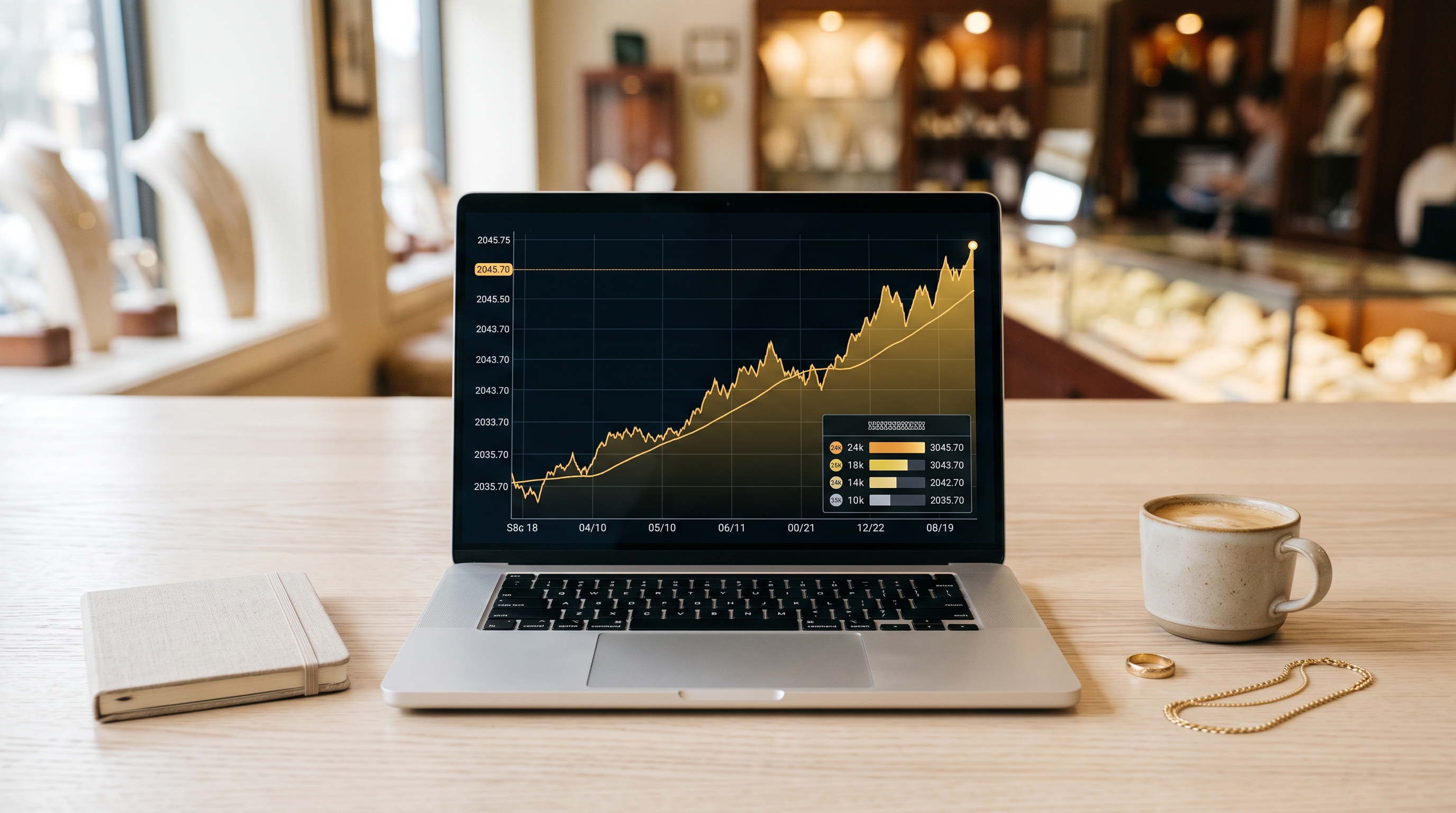
- A live or frequently updated gold price page showing current spot price per gram, ounce, and common purities (24k, 18k, 14k, 10k), ideally with a simple visual chart showing recent trends
- An evergreen explainer on how gold prices are actually determined — spot price, purity, weight, and how those factors interact with what a buyer will actually pay
- A recurring pricing update post or newsletter — weekly or monthly — that contextualizes recent price movement in plain language, without financial jargon
- A calculator tool that lets visitors estimate the value of a piece by entering weight and purity, which is one of the most consistently high-converting content formats in this category
- A glossary of common terms — karat, troy ounce, hallmark, spot price — that captures long-tail searches from people just beginning to educate themselves
This kind of hub does two things simultaneously. It captures search traffic across dozens of related keyword variations, and it positions the business as a transparent, trustworthy authority rather than a company that only talks about price when it benefits them.
Turning Price Volatility Into a Content Calendar
Because gold and silver prices genuinely move — sometimes dramatically — there's a natural content calendar built into the commodity itself. Smart jewelry businesses treat every meaningful price movement as a content opportunity rather than something to react to only internally.
Useful recurring content formats include:
- "Gold Hits New High: What It Means If You're Thinking About Selling" — published whenever prices spike meaningfully
- Quarterly or annual "Gold Price Outlook" posts that summarize expert commentary and historical patterns, written in accessible language
- "Why Did Gold Prices Drop This Week?" explainer posts tied to specific economic events, translated into plain terms for a non-financial audience
- Seasonal pieces tied to predictable selling patterns — post-holiday debt relief, tax season, back-to-school expenses — that connect broader financial pressures to the option of selling unused gold
"We publish something almost every time there's meaningful movement in the market," Avi-Meir Zaslavsky explains. "Not because we're trying to create urgency artificially — the urgency is already there in the headlines. Our job is just to translate what a 3% jump in spot price actually means for the ring sitting in someone's drawer."
This steady rhythm of timely, price-anchored content also signals freshness to search engines, which tend to favor sites that demonstrate ongoing activity and topical relevance over those with a handful of static, outdated posts.

Making Complex Pricing Genuinely Understandable
One of the most persistent challenges in this content category is that gold pricing involves several layered concepts — spot price, purity, weight, melt value, and the margin a buyer needs to operate profitably — that can confuse a first-time seller. Content that oversimplifies erodes trust; content that's too technical loses the reader entirely.
The most effective approach tends to break pricing education into digestible layers:
- Start with the single most relevant number: today's price per gram at common purities
- Explain, in a sentence or two, why the price a customer receives is typically below the pure "melt value," and why that's normal and fair rather than a red flag
- Use visual aids — simple tables or charts comparing purities side by side — rather than dense paragraphs of numbers
- Include real, worked examples: "A 10-gram, 14k gold necklace, at today's prices, would have an approximate melt value of roughly X" — concrete numbers make abstract pricing concepts click
- Address the emotional side directly: many first-time sellers worry they're being lowballed, so proactively explaining how offers are calculated defuses that anxiety before it becomes an objection
This kind of transparent breakdown does something subtle but important: it pre-empts the most common point of friction in the actual sales conversation. A customer who already understands, roughly, why their offer isn't equal to the "melt value" they saw quoted online arrives calmer, better informed, and generally more trusting of the business explaining it to them.

Video and Visual Content for a Skeptical Audience
Text-based explainers matter, but gold pricing content also benefits enormously from visual and video formats, particularly because so much of the audience's hesitation is rooted in not trusting what they can't see. A short video walking through how a scale works, how purity is tested, and how a final offer is calculated does more to build confidence than paragraphs of text ever could.
Effective visual content formats include:
- Short "behind the counter" videos showing the actual appraisal process from intake to offer
- Simple animated or static infographics explaining karat purity in visual terms (a pie chart showing gold content vs. alloy, for instance)
- Screen-recorded walkthroughs of an online pricing calculator in use
- Time-lapse or comparison charts showing how gold prices have moved over the past year, updated periodically
"People are naturally suspicious of a process they can't see," Avi-Meir Zaslavsky notes. "Showing the scale, showing the testing, showing how we get from a weight and a purity to a number — that transparency does more for conversion than any discount or promotion we could offer."
Repurposing Price Content Across Channels
A well-built gold price content hub shouldn't live only on a blog page. The same underlying data and explainers can be repurposed efficiently across multiple channels, extending reach without proportionally increasing the workload:
- Short-form social posts summarizing weekly price movement, formatted for quick scanning
- Email newsletters sent to past customers when prices hit notable thresholds, gently reminding them of the option to sell without being pushy
- Google Business Profile posts referencing current buy prices, which also reinforces local SEO signals
- Local press outreach whenever prices hit unusual highs or lows, since gold price movement is a recurring, low-effort local news hook that journalists are often receptive to
This kind of repurposing means a single piece of well-researched pricing content can generate value across search, social, email, and local press simultaneously, rather than being written once and forgotten.

Measuring What Content Marketing Actually Delivers
As with any content strategy, it's worth being disciplined about what success actually looks like. Traffic to a gold price page is a reasonable early indicator, but the more meaningful metrics tend to be:
- Conversion rate from the pricing calculator or explainer pages into an actual quote request or store visit
- Email newsletter open and click rates on price-update sends
- Return visitor rate on pricing content specifically, which indicates the "checking repeatedly before selling" behavior mentioned earlier
- Ranking improvements on the broader cluster of pricing-related keywords over time, not just the single most competitive term
Businesses that track this closely often find that pricing content, while less flashy than product photography or design-forward jewelry content, quietly outperforms almost everything else in the content library when it comes to actual conversion into transactions.
Bringing It Together
Content marketing around gold and silver pricing occupies a rare position: it's genuinely useful to the reader, tied to a naturally recurring search behavior, and directly connected to commercial intent, all at once. A business that builds a real education hub — live pricing, clear explainers, a useful calculator, and a steady rhythm of timely updates — isn't just producing blog content. It's building the resource that a hesitant, financially motivated customer returns to again and again before finally deciding where to sell.
"Price is the thing people are searching for, but trust is the thing they're actually looking to find," Avi-Meir Zaslavsky reflects. "If your content answers the question honestly, every single time, you become the place people trust with the answer — and eventually, with the gold itself."
For jewelry and gold-buying businesses willing to invest in this kind of ongoing, transparent education rather than one-off promotional posts, gold price content represents one of the most reliable, evergreen traffic and conversion engines available in the category — one that renews itself every time the market moves.
.png)